AI SEO is the process of improving a brand's visibility across traditional search engines, AI-generated results, answer engines, and Large Language Models.
So, what is AI SEO in practice?
It is a comprehensive search strategy that combines traditional techniques with modern methods designed to help systems discover, understand, retrieve, summarize, mention, and cite your information.
What is this discipline beyond using automated tools to create content? It includes clear answer-first writing, consistent brand and entity information, structured data, technical accessibility, and trustworthy content that systems can interpret accurately.
This approach does not replace traditional search engine optimization, and it cannot guarantee rankings, citations, or inclusion in generated answers.
This guide explains how AI SEO works, how it differs from traditional methods, and how related disciplines such as Generative Engine Optimization and model optimization fit together.
You will also learn about core strategy elements, measurement, tools, common mistakes, and where the industry is heading.
First, let's define the main ideas behind this approach.
What is AI SEO? At its core, it expands search optimization beyond blue-link rankings to ensure your brand thrives in an era of AI-driven search. By adopting this approach, you improve the chances that search systems and intelligent assistants can find, understand, trust, and use your information. AI SEO also supports clearer brand representation when systems generate responses for your audience.
Think of an AI search system as a research assistant with several stages of work. First, it needs to discover information. Crawlers may find web pages through links, XML sitemaps, feeds, and other publicly available sources. Some systems also use connected databases, business profiles, product catalogs, structured data, and licensed content.
After discovery, the system processes and stores information in an index or another searchable data store. Google explains that search systems analyze page content, images, and videos before storing information in its index. You can review Google's explanation of how search works for the traditional process behind crawling, indexing, and serving results.
The next step is interpretation. Systems look beyond individual keywords to understand user intent, topics, entities, and complex relationships. Achieving entity clarity is crucial here; for example, a page about Apple repair needs to be understood in context. Is it about the technology company, a fruit orchard, or a local repair shop? Clear wording, consistent entity information, headings, links, and structured data help reduce that confusion.
When someone submits a prompt, the system retrieves potentially useful information and evaluates it. Relevance matters, but it is not the only factor. The system may also assess credibility, freshness, accessibility, consistency, and supporting evidence. Firsthand details, clear authorship, reputable references, and agreement across trusted sources can help a page provide stronger evidence.
The final system may rank your page, summarize part of it, mention your brand, or cite the page as a source. Sometimes your content supports an answer without receiving a visible click, a common result known as zero-click search.
AI SEO isn't a single formula because each platform uses different systems, data sources, and evaluation methods.
Google Search, Google AI Overviews, ChatGPT, Perplexity, Microsoft Copilot, and Gemini may retrieve and assess information in different ways. So, optimize the fundamentals consistently, but do not expect one tactic to produce the same result everywhere.
Traditional organic listings are still an important form of search visibility. Your page can rank on a search engine results page, earn a featured snippet, or attract clicks through a title and description. Modern strategies add other outcomes that may appear before, beside, or instead of those listings.
Google AI Overviews and other generated search features can provide a direct response with links to supporting sources. Conversational assistants and chatbots may answer a question in a longer exchange, while knowledge panels can display facts about a company, person, product, or location. Voice experiences may read a concise answer aloud instead of presenting a page list.
You may also see visibility in product research results and comparison responses. A system could mention your brand as an option, recommend a product, quote a page, or use your information behind the scenes while producing a broader answer.
These outcomes are useful signals, but they are not guaranteed. A system may show a citation for one prompt and omit it for another. Results can also change based on the user's location, wording, device, account settings, available sources, and the platform's retrieval process.
For that reason, track more than rankings. Look for brand mentions, citations, included products, answer accuracy, referral traffic, and the questions where your business appears. Visibility is broader than a position number, but it still needs careful measurement.
What is AI SEO in practice? AI SEO includes the traditional work that helps pages rank, plus optimization for systems that summarize, answer, cite, and recommend information.
What is AI SEO not? It is not a replacement for search engine optimization. It is a broader strategy built on the same foundation.
Traditional search engine optimization (SEO) improves visibility in organic search results. It starts with useful content that matches what people want to accomplish, whether they are researching a topic, comparing products, finding a service, or ready to buy.
Strong SEO also includes on-page optimization, descriptive headings, relevant titles, clear URLs, internal links, and useful supporting details. Technical SEO helps search engines access, crawl, and understand the site. Site architecture connects related pages, while backlinks and other external references can support authority and discovery.
User experience matters, too. Pages should load efficiently, work well on mobile devices, remain easy to navigate, and help visitors find the next answer without unnecessary friction. Google's explanation of how search works covers the relationship between crawling, indexing, and search results.
These practices still matter when AI systems retrieve information. Clear content is easier to interpret. A logical site is easier to explore. Reliable pages with strong supporting references are easier to trust. Traditional SEO is not an outdated practice that AI SEO replaces. It is the base that makes the broader approach possible.
AI optimization means making your brand, website, and content easier for AI systems to discover, understand, retrieve, and use. Those systems may support search results, chat responses, voice tools, product research, or business recommendations.
The term can act as an umbrella for Generative Engine Optimization, Answer Engine Optimization, and Large Language Model Optimization. However, agencies and software providers do not always use these labels in the same way. One provider may call a service GEO, while another describes similar work as AI SEO.
The shared focus is broader than keyword placement. It includes technical accessibility, clear entities, schema markup to define data, and semantic search strategies to help machines understand context. Your company, products, locations, services, and experts should be easy for systems to distinguish from similar names and competing information.
| Discipline | Primary Focus |
|---|---|
| Traditional SEO | Ranking in organic search results |
| AEO | Providing direct answers to specific queries |
| GEO | Earning citations in generative search results |
| LLMO | Entity consistency and brand authority |
That distinction matters because AI platforms combine many sources. Consistent first-party details, credible mentions, and well-organized pages give those systems fewer reasons to misunderstand your brand.
Generative Engine Optimization focuses on visibility inside answers produced by generative search engines. The desired outcome may be a citation, a source link, a brand mention, or inclusion in the answer itself.
For example, an AI system might compare accounting software and mention your product as an option. It might cite your pricing page, quote a guide you published, or use your research while creating a broader response. These are different outcomes from ranking in a traditional list of links.
GEO does not mean inserting special phrases designed for an AI system. There is no reliable sentence pattern that forces a platform to cite your page. Instead, the work depends on useful information, clear claims, supporting evidence, and content that a system can retrieve and present with confidence. The relationship between GEO, AEO, LLMO, and AI SEO also varies by provider, as this terminology comparison explains.
Answer Engine Optimization helps content provide a clear, accurate, extractable answer to a specific question. It connects with featured snippets, voice assistants, knowledge panels, search answer boxes, and AI answer systems.
A page may improve clarity by defining a term directly, placing a concise answer near a question-based heading, and following it with supporting details. Lists, short explanations, and descriptive subheadings can also help systems identify the information a reader needs.
For example, a page answering "What is technical SEO?" could begin with a direct definition, then explain crawling, indexing, site speed, and structured data. That format supports both human readers and systems looking for a focused answer.
Formatting can improve understanding, but it does not guarantee a featured result or voice response. Accuracy, relevance, authority, and the searcher's intent still influence which answer gets selected.
Large Language Model Optimization focuses on how brands and information are represented, retrieved, mentioned, or recommended by systems built on Large Language Models.
Your identity should be easy to distinguish. That includes your company name, products, people, locations, areas of expertise, and relationship to other organizations. Consistent information across your website, business profiles, industry publications, reviews, and trusted third-party sources gives systems more evidence to connect those entities correctly.
First-party content explains what you offer and what you know. External citations and corroboration show that other reliable sources recognize the same facts. Structured content makes those details easier to process, while clear author information helps connect expertise to the claims being made.
LLMO is not about controlling an AI model's response. It is about creating a consistent, well-supported record of your brand that systems can identify and use accurately.
AI SEO functions as a coordinated framework that bridges traditional search, answer systems, and modern language models. Rather than operating in silos, these disciplines work in harmony to make your digital presence accessible, accurate, and authoritative across every touchpoint. This comparison of SEO, AEO, and GEO highlights how these paths converge to maximize brand visibility.
To see these disciplines in action, consider a B2B managed IT firm targeting manufacturers in Ohio. Success here requires a multifaceted strategy that addresses different retrieval methods simultaneously.
By refining content to be technically accessible, answer-focused, and rich in proprietary evidence, you create a cohesive strategy that satisfies both traditional algorithms and generative search. The objective is to build a digital presence that provides value through each of these pathways, ensuring your brand remains a trusted source regardless of how a user chooses to search.
Traditional SEO still supports rankings, crawling, indexing, and organic clicks. AI SEO expands that work by helping systems interpret, summarize, cite, and recommend your information across conversational search experiences. AI SEO is a broader visibility strategy, not a replacement for the fundamentals that already help search engines understand your website.
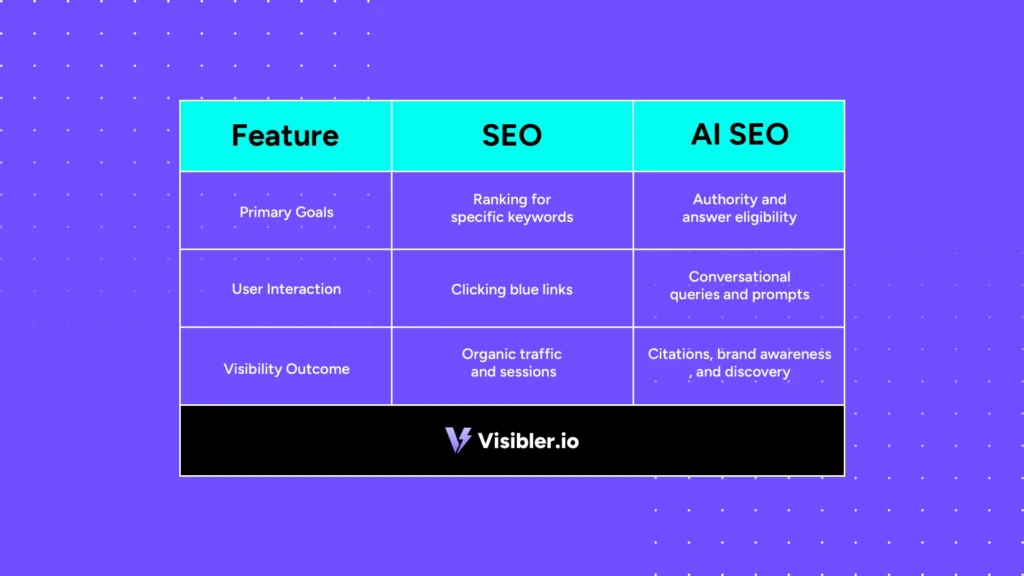
| Feature | Traditional SEO | AI SEO |
|---|---|---|
| Primary Goal | Ranking for specific keywords | Authority and answer eligibility |
| User Interaction | Clicking blue links | Conversational queries and prompts |
| Visibility Outcome | Organic traffic and sessions | Citations, brand awareness, and discovery |
AI SEO matters because people increasingly search through conversations, comparisons, and follow-up questions. Instead of typing one phrase into Google and scanning links, a buyer may ask an AI system to compare accounting software, find a local attorney, or recommend a product for a specific use case.
That creates more opportunities for brands and publishers to appear across AI search platforms. Your page may be ranked in traditional results, cited in AI Overviews, mentioned in a chatbot response, or used as supporting information in a product comparison. Each outcome gives your business another chance to be discovered.
AI search also changes how people research. A user can ask several related questions in one conversation, refine the criteria, and request a recommendation. Content that answers those questions clearly gives the system useful material to retrieve. It also gives the reader a better experience when they visit your website.
Clear content matters more than clever wording. Define terms directly, explain who a product is for, answer common objections, and separate facts from opinions. Add firsthand details, accurate examples, pricing conditions, limitations, and evidence where appropriate. These details help both readers and AI systems understand what your brand actually offers.
External recognition matters, too. Consistent brand mentions in reputable publications, industry directories, reviews, interviews, and professional profiles can help connect your brand with the right topics and entities. Research on AI search citations and brand visibility also highlights the growing importance of being referenced inside answers, not just listed in search results.
The business outcomes can include more brand recognition, additional citations, qualified referral traffic, and organic visits from people with clearer intent. A reader who encounters your company during a comparison may already understand your category, strengths, and relevance before reaching your site.
But AI visibility doesn't always produce an immediate visit. This shift has led to the rise of zero-click search, where some interfaces answer the question on the results page or inside the conversation, leaving the user with no reason to click. That can reduce website visits for certain informational searches.
A citation may not create a click today, but it can help a buyer recognize and remember your brand later.
For that reason, measure more than sessions. Track referral traffic, branded searches, assisted conversions, qualified leads, citations, and the accuracy of how systems describe your company. As research on Google AI citations suggests, citations deserve attention even when their direct traffic value is difficult to isolate.
AI SEO improves eligibility and understanding, but it doesn't control an AI system's response. Results can change based on the platform, user prompt, location, time, available sources, account settings, and model behavior.
A page may appear in one answer and disappear from another. One system may cite your article, while another uses a different source or provides no citation at all. The same brand can also receive different descriptions as models update their data and retrieval processes.
Structured data, strong traditional rankings, expert content, consistent business information, and reputable mentions can help systems interpret your site. They may also improve the chance that your content is retrieved for relevant questions. None of these elements guarantees inclusion, citation, recommendation, ranking, or conversion.
Don't treat schema markup as a request form for AI visibility. It describes your content, but the platform still decides whether the information fits the user's question and meets its own quality requirements. The same applies to publishing more articles or earning additional mentions.
Focus on what you can control:
AI SEO is a way to improve how your information can be found and understood. It isn't a promise that every system will mention your brand. Use it to strengthen usefulness, trust, accuracy, and measurable performance across the search experiences your audience already uses.
What is an effective AI SEO strategy without a technically accessible website? What happens when content fails to answer real questions, or when brand information lacks the necessary external trust to be recognized? A complete strategy connects Technical SEO, comprehensive audience research, entity clarity, high-quality content, authority, and measurement.
AI systems need access to your content before they can interpret, summarize, or cite it. Prioritize your Technical SEO by checking crawlability, indexability, rendering, and HTTP status codes. Important pages should not be blocked by robots.txt, hidden behind forms, or dependent on broken JavaScript rendering.
Site performance also affects the experience around your content. Improve Core Web Vitals, reduce unnecessary scripts, support mobile usability, and fix layout problems that make pages difficult to read. A clear information architecture helps crawlers and visitors understand how your homepage, category pages, service pages, and supporting articles relate to one another.
Internal links provide those relationships. Link from broad topics to detailed pages, use descriptive anchor text, and avoid leaving important content several clicks away. Google's guide to AI search features reinforces the need for publicly accessible, indexable content.
Structured data adds another layer of clarity for search engines. By implementing Schema markup, you help machines interpret information more accurately. While Schema markup does not guarantee a rich result, citation, ranking, or AI mention, it is a foundational component of modern discovery. Depending on the page, relevant types may include Organization, Article, Product, FAQ, HowTo, LocalBusiness, and Review. Validate your code with tools such as Google's Rich Results Test to confirm your data is correct, as this can still lead to traditional rich snippets in standard search results.
Start with the questions your audience asks rather than a list of terms you want to repeat. Effective keyword research should focus on informational questions, comparison queries, commercial research, and conversational prompts. Always prioritize user intent, as a buyer may ask what a service does, compare providers, question the price, and then ask which option fits a specific situation.
Map each main question with its likely follow-ups, objections, definitions, examples, and decision factors. This creates a more useful content brief and prevents the page from answering only the first sentence of a larger conversation.
Topic clusters are usually stronger than isolated keyword pages because they connect related information. A central guide can link to pages about costs, use cases, alternatives, implementation, and common problems. Those connections help readers continue their research and help systems understand the subject's breadth.
Use natural language that matches how people speak and search. Clear coverage, accurate terminology, and complete answers matter more than forcing the same phrase into every heading.
AI systems need to connect facts to the correct company, product, person, place, or topic. Achieving entity clarity across your website, including your official name, products, services, locations, and areas of expertise, is essential.
Keep organization details consistent in business profiles, industry directories, review platforms, and trusted publications. Differences in names, addresses, phone numbers, or leadership details can make entity matching harder. Consistency gives systems more evidence that separate references describe the same business.
Explain relationships, too. Identify which people work for the company, which products belong to the brand, and which experts support a topic. Relevant schema types can reinforce those connections.
Link to official or canonical references when they clarify an entity or claim. Don't add unrelated names, places, or schema types just to appear connected. Artificial entity stuffing creates noise instead of useful context.
Put the direct answer near the top of the page. Then add a clear definition, descriptive headings, short summaries, lists, steps, comparisons, and FAQs where they help the reader. This structure makes important information easier for people to scan and easier for systems to extract.
Strong content also adds information that generic pages do not have. Use source attribution, original research, expert input, firsthand examples, updated facts, transcripts, captions, and descriptive image alt text. Citable atomic facts, such as a precise definition or documented result, give systems reliable pieces to retrieve.
Information gain matters here. Explain what your business has observed, tested, measured, or learned instead of repeating the same advice found everywhere. Help people first, then organize the page so key ideas are easy to identify and quote accurately.
Relevant backlinks, brand mentions, reviews, expert citations, and industry publications all help build the topical authority required for your brand to be recognized as a reliable source. Consistent third-party information helps confirm that your company does what its website says it does.
Publishing large volumes of similar pages cannot replace external authority. Focus on useful coverage, then earn references through original research, strong customer experiences, expert contributions, and credible industry participation.
Track traditional rankings and organic traffic alongside referral traffic from AI platforms, AI citations, brand mentions, prompt-level visibility, share of voice, and assisted conversions. Review the accuracy of generated descriptions, too. A brand mention is more useful when the system identifies the right service, audience, location, and differentiator.
What is AI SEO when you need a practical plan? Beyond simply publishing more content, a modern AI SEO strategy serves as a framework to help the right systems find, understand, cite, and accurately describe your brand. This approach requires auditing your current visibility, mapping specific topics and prompts, improving existing pages, building external trust, and tracking performance over time.
Start with your existing performance instead of guessing where the gaps are. Review rankings, impressions, organic traffic, indexed pages, existing citations, brand mentions, and referral traffic from various search platforms. Look for common questions where your brand appears, then identify important queries where competitors are featured but your business is missing.
Create a fixed prompt set using real customer language. Include informational, comparison, purchase, support, and follow-up questions. Test the same prompts across AI Overviews, ChatGPT, Perplexity, Gemini, or other platforms your audience uses.
Record the date, location, platform, model or product, exact prompt, response, cited sources, competitors mentioned, and whether your brand was recommended. Note sentiment and any inaccurate claims about your company. Tools and manual tracking can both help, but consistency matters more than complexity. Search visibility measurement guidance from Moz provides a useful foundation for organizing this work.
AI answers can vary between users and sessions. One successful test is not proof of permanent visibility, so repeat the same tests on a regular schedule.
Define the entities your business needs systems to understand. Include your brand, products, services, experts, locations, audiences, business categories, and important partners. Then check whether these details are consistent across your website, profiles, reviews, directories, and industry publications.
Map traditional searches alongside conversational prompts. A buyer might search "managed IT services for manufacturers," then ask an AI system, "Which managed IT providers understand manufacturing compliance?" Both queries address the same need, but the wording and expected response differ.
Organize questions by the customer's stage:
Build topic clusters around these needs, with a central page connected to detailed supporting content. Using a topical authority map can help you establish topical authority by assigning each query to an existing or planned URL. Mark gaps where competitors are cited or recommended, but your site lacks clear, supported information.
Fix technical barriers before creating new pages. Check crawlability, indexability, rendering, broken links, redirects, mobile usability, and page speed. Then update existing pages that already have impressions or relevant authority. Improving a useful page is often more efficient than starting from zero.
Organize related pages into topic clusters, answer important questions directly, and add original evidence. Include firsthand observations, expert commentary, product details, documented results, limitations, examples, and reliable sources. Improve author bios and organization details so readers and systems can identify who created the content and why the business is qualified.
A canonical answer block of two to four sentences can clarify the main response near the top of a page. It is not a ranking shortcut or a guarantee of AI citations. Follow it with context, evidence, examples, and related questions.
Connect supporting pages with descriptive internal links. If AI helps draft or update content, review every draft for factual accuracy, originality, tone, sourcing, and real experience before publication. Automated wording is not a substitute for subject knowledge.
Your website makes the claims, but independent sources help confirm them. Look for relevant digital PR, expert contributions, industry publications, customer reviews, partnerships, community participation, and accurate business listings. Effective link building acts as a vital component of this authority section, as it helps establish external validation of your brand's expertise.
A manufacturer may gain useful recognition through an industry association, a technical interview, a customer case study, or a respected trade publication. A local service company may need consistent profiles, genuine reviews, and community references that confirm its location and services.
This independent corroboration helps systems assess whether your brand's claims exist outside its own website. It can also clarify your relationship to a category, audience, product, or area of expertise.
Don't pursue mass outreach or manufactured mentions. A small number of relevant, trustworthy references is more useful than a large collection of unrelated placements. The question is simple: would a knowledgeable customer consider this source credible?
Review rankings, citations, brand mentions, referral traffic, qualified leads, assisted conversions, and prompt-level visibility on a regular schedule. Compare your results with competitors, then check which pages and sources appear most often in AI responses.
Tie changes to specific actions. A visibility increase may follow a content update, technical fix, new review, expert contribution, internal linking change, or platform update. Record those changes so you can separate real progress from normal answer variation.
Refresh facts, dates, statistics, pricing details, examples, author information, and product descriptions as customer questions change. AI search interfaces also change, so keep testing your fixed prompt set and add new prompts when buyers ask different follow-up questions. The strategy should be measured, updated, and connected to business results, not treated as a one-time content project.
What Is AI SEO without reliable research, content, technical, and measurement tools? What Is AI SEO when systems change across platforms? What Is AI SEO in daily work? It is a repeatable process that uses tools to improve discovery, understanding, visibility, and business results. No platform is universally best, so choose your AI SEO tools based on your site, audience, resources, and reporting needs.
Different tool categories answer different questions. Use a focused stack instead of buying every platform available.
This guide to SEO in the age of generative AI also reinforces the need to prioritize useful content over publishing volume.
Answer the main question early. Use clear, specific language, descriptive headings, and short sections that help readers find the information they need. Build each page around a topic and its related questions instead of repeating one isolated keyword. Incorporating high-quality AI SEO tools into your workflow ensures you stay focused on user intent rather than just ranking metrics.
Support important claims with trustworthy sources, current facts, accurate dates, and updated statistics. Add original data, firsthand observations, expert insights, examples, and limitations that generic pages don't offer. Make the author and organization easy to identify through bylines, credentials, contact details, and clear business information.
Connect related pages with descriptive internal links. Earn relevant independent mentions through useful research, customer experiences, expert contributions, industry publications, and legitimate digital PR. Track rankings, organic traffic, citations, mentions, referral visits, leads, and conversions across several search and AI platforms.
Use AI to improve research and production, but never write only for machines. A page that satisfies a system while confusing or disappointing people has failed.
Treating AI SEO as chatbot keyword stuffing creates awkward pages and weak answers. Creating near-identical definition pages also wastes resources when one well-organized guide could cover the topic better. Ignoring technical SEO prevents systems from accessing content, regardless of how polished the writing looks.
Unsupported claims damage trust, while publishing AI-generated content without expert review can introduce false facts, outdated details, and generic advice. Measuring metrics without connecting them to qualified traffic, leads, sales, or brand accuracy makes the data difficult to act on.
Schema describes page content, but it doesn't guarantee inclusion, citations, or rankings. Off-site authority still matters, and tracking only one AI platform gives you an incomplete view of visibility. No selection of AI SEO tools can guarantee that an AI system will cite your page.
A future supporting article can examine these mistakes in greater detail. For now, focus on useful content, technical access, credible evidence, consistent entity information, and measurement tied to real business outcomes.
Measuring success is essential for understanding your progress. You must track several outcomes together, because no single metric provides the full picture when implementing AI SEO.
Start with traditional search visibility. Track rankings, impressions, and organic clicks in Google Search Console. Rankings show position, impressions show how often your pages appear, and clicks show whether people choose your result. These metrics still matter, even when AI answers occupy more search space.
AI visibility needs its own measurement process. Test a fixed set of prompts across the platforms your audience uses, then record brand mentions, citations, answer inclusion, cited URLs, and prompt-level presence. A citation may point to your homepage, a service page, or a supporting article. Those details matter because visibility without the right source or context may not help your business.
Brand presence adds another layer. Monitor share of voice against competitors, the sentiment attached to your brand, and entity accuracy. Does the system identify the right company, location, product, audience, and specialty? An inaccurate recommendation can create confusion even when your brand appears often.
Acquisition metrics connect visibility with business results. Review referral traffic from AI platforms, organic traffic, engaged sessions, qualified inquiries, leads, and assisted conversions. AI answers may influence a buyer before that person later returns through direct traffic, branded search, or a sales conversation.
Content performance shows whether your coverage is useful. Track the queries covered, pages referenced, citations earned, and follow-up questions answered. A page that answers the first question but misses pricing, limitations, or implementation concerns may attract visibility without supporting a decision. Review community discussion about AI SEO measurement for the practical challenge of connecting AI answers with analytics.
Use two or three case studies in a consistent format. For each example, explain the initial problem, work completed, visibility change, traffic change, time frame, and limitations. Identify the platforms and prompts tested, especially when the example involves generated answers.
Separate correlation from causation. A citation increase after a content update may also involve seasonality, a platform change, new links, or stronger brand awareness. State what changed, what was measured, and what cannot be proven.
Statistics require the same discipline. Include a direct source, publication date, methodology, sample or population details, and the original context. If reliable evidence is unavailable, use a qualitative example instead of inventing a number.
Search may become more conversational, with users moving between traditional results, generated answers, and follow-up prompts. Brand recognition and entity accuracy may become more important as systems compare businesses and summarize their differences.
Original data should also gain value because firsthand research gives AI systems something distinct to reference. Measurement will likely move beyond rankings toward citations, mentions, answer accuracy, qualified actions, and assisted conversions.
SEO, content, public relations, and brand authority will work more closely together. Agentic AI, multimodal content, and new technical protocols are emerging areas to watch, not guaranteed requirements.
Is AI SEO different from SEO?
AI SEO expands traditional SEO to include AI answers, citations, mentions, entity accuracy, and prompt-level visibility. Traditional crawling, indexing, rankings, links, and organic traffic still provide the foundation.
Is GEO part of AI SEO?
Yes. Generative Engine Optimization is commonly treated as one part of AI SEO. GEO focuses on visibility inside generated responses, including mentions, citations, recommendations, and source links.
What Is the Difference Between GEO and LLMO?
GEO focuses on generative search answers. Large Language Model Optimization focuses more broadly on how language models identify, retrieve, describe, and recommend your brand, products, and expertise.
Does AI SEO replace traditional SEO?
No. Technical accessibility, useful content, internal linking, authority, and organic search performance remain important. AI SEO adds new visibility goals rather than removing existing SEO work.
How Do You Optimize Content for AI Search?
Answer questions directly, use clear headings, support claims with evidence, add original details, maintain accurate entity information, and make important pages accessible to crawlers. This approach often involves Answer Engine Optimization to ensure your content is structured for direct retrieval.
Can AI SEO Guarantee Citations?
No. Platforms choose sources based on relevance, trust, availability, prompt wording, and system behavior. Strong content may improve eligibility, but no tactic guarantees a citation in an AI Overview.
How Long Does AI SEO Take?
Timing varies by site authority, competition, technical condition, content quality, and platform. You might see faster results in a platform like ChatGPT, but you should track progress over several testing cycles instead of expecting a fixed result.
How Do You Measure Visibility in AI Answers?
Use a fixed prompt set and record mentions, citations, answer inclusion, cited URLs, competitors, sentiment, and accuracy across relevant platforms.
Do Backlinks Matter for AI SEO?
Relevant backlinks can support discovery, authority, and corroboration. They don't guarantee AI visibility, and unrelated links usually provide little value.
Does Structured Data Help AI Search?
Structured data can clarify products, organizations, authors, services, and relationships. It supports interpretation, but it doesn't guarantee rankings, rich results, or citations.
What Are the Best AI SEO Tools?
Use a combination of Google Search Console, analytics, technical crawlers, content tools, brand monitoring, and prompt tracking. The best stack depends on your goals and audience.
What is AI SEO? It expands traditional search optimization so search engines, answer engines, and language models can discover, understand, trust, mention, and cite your brand.
In practice, AI SEO combines technical accessibility, evidence-based content, clear entities, and authority beyond your website. Ultimately, this approach aims to improve your qualified visibility and ensure accurate brand representation across the complex landscape of AI-driven search.
Citations and recommendations are not guaranteed, so you should not judge performance by mentions alone. Instead, track traditional rankings, citations, referral traffic, qualified leads, conversions, and the accuracy of how language models describe your business.
Remember that business outcomes matter more than vanity metrics. By prioritizing high-quality content optimization, you ensure that your brand remains a reliable source for both users and emerging AI platforms.
If you need help putting this strategy into practice, Visibler.io is an AI SEO agency that can audit your current visibility, build a focused strategy, improve your content and technical foundations, and track performance across search and AI platforms.

Visibler — Made with  in Malaysia
Level 33, Ilham Tower, No. 8, Jalan Binjai, Kuala Lumpur 50450, Malaysia